
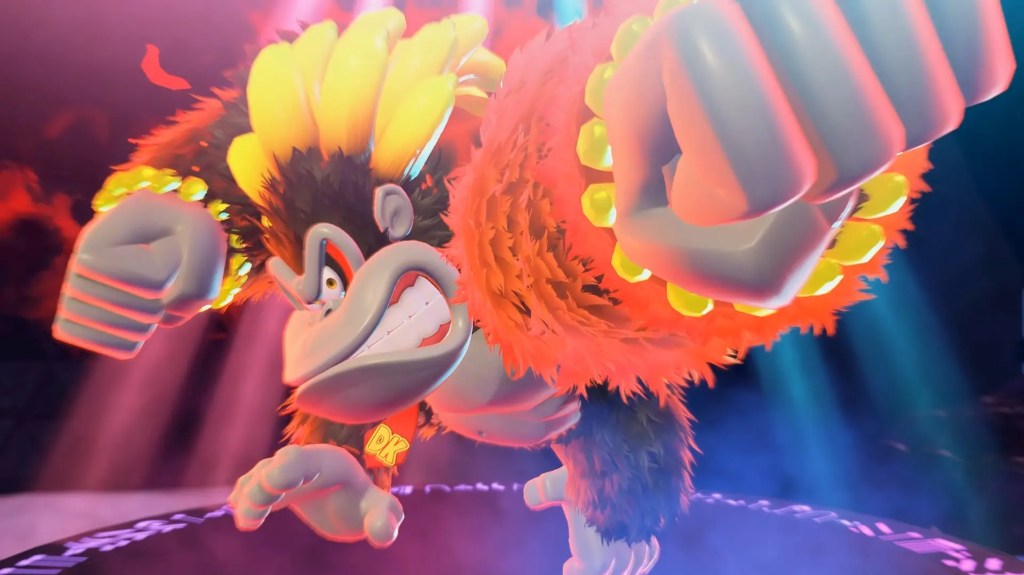
In a surprising revelation, Nintendo has confirmed that Donkey Kong Bananza, the highly anticipated new entry in the iconic franchise, was originally in development for the Nintendo Switch 1 before ultimately being moved to the Switch 2 due to technical constraints.
A Project Years in the Making
Development on Donkey Kong Bananza began shortly after the release of Super Mario Odyssey in 2017. The project was helmed by Nintendo EPD, the same internal studio behind Odyssey, and aimed to completely reinvent the Donkey Kong formula by embracing massive, destructible voxel environments. The vision was ambitious: a sandbox-style game where players could reshape the terrain, destroy buildings, and create chaos on a scale the series had never seen.
According to recent reports from multiple outlets, including GamesRadar and Polygon, this concept was originally prototyped and partially built on the Switch 1 hardware. Early internal builds showcased a destructible jungle environment and featured co-op mechanics built around traversal and environmental interaction.
Technical Limitations Spark Platform Shift
While the game technically ran on the original Nintendo Switch, the developers quickly encountered hard limits. The voxel-based system, which allows for highly dynamic environmental destruction and reconstruction, proved to be too demanding for the Switch 1’s aging Tegra X1 chip.
Nintendo executives reportedly realized that in order to deliver on the team’s full vision including seamless terrain manipulation, persistent destruction, and large-scale enemy battles they would need more power under the hood. Thus, the decision was made to shift Donkey Kong Bananza to the next-generation Switch 2, where new hardware features like improved RAM, faster load times, and GPU enhancements could better support the scale and fidelity the team envisioned.
“Continuity of Destruction”
A central design pillar of Bananza is what the developers call the “continuity of destruction” a world that remembers the player’s actions. If you collapse a bridge, smash a fortress, or blow up a part of the jungle, those changes remain persistent throughout the playthrough. It’s a major evolution in game design for the Donkey Kong series, which has traditionally relied on more linear or puzzle-based levels.
This mechanic simply wasn’t feasible on the original Switch hardware, especially not at the scale Nintendo wanted. With the added horsepower of the Switch 2, however, Bananza can render fully destructible levels, simulate large crowd interactions, and allow players to alter the landscape in real time.
A New Era for Donkey Kong
Donkey Kong Bananza represents a bold new direction for the franchise. Rather than relying solely on traditional platforming, it embraces physics-driven gameplay, sandbox elements, and next-gen destruction tech. The move to the Switch 2 has allowed the game to fully embrace this vision, offering a more dynamic and reactive world than ever before.
Long-time fans of the series will still find familiar elements barrel cannons, mine cart chases, and tropical environments but everything is now woven into a larger, living ecosystem. The game also features a broader cast, including Diddy Kong, Cranky Kong, and Dixie Kong, each with unique abilities tied into the destructible world systems.
The reveal that Bananza was originally built for the Switch 1 sheds light on just how far Nintendo is pushing the Donkey Kong franchise.
With its massive sandbox design, environmental permanence, and playful chaos, Donkey Kong Bananza could mark the start of a new golden era for the Kong family.




 1-Up Games