
French publisher Nacon is facing an uncertain future after formally filing for insolvency and requesting the opening of judicial reorganization proceedings.
In a statement, the company confirmed it has applied to the Lille Métropole Commercial Court in France, seeking legal protection as it attempts to stabilize its financial position and avoid a potential collapse.
What Happened?
According to Nacon, the move comes after it was unable to make a partial repayment on a bond loan owed to shareholders. The publisher cited an “unexpected and late refusal” from its banking pool, which reportedly declined to move forward with anticipated financial support.
That refusal appears to have triggered immediate liquidity issues.
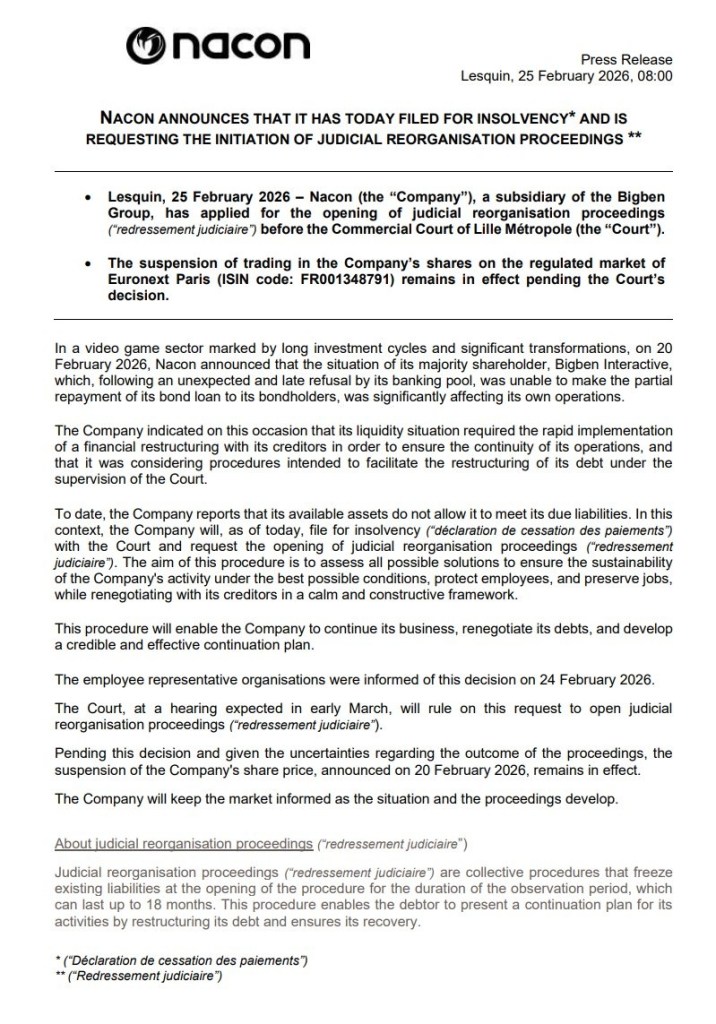
In its announcement, Nacon said its financial situation now requires “the rapid implementation of a financial restructuring with its creditors in order to ensure the continuity of its operations.”
In simple terms: the company needs time, legal protection, and cooperation from creditors to restructure its debts or it risks something far more severe.
What Judicial Reorganization Means
Judicial reorganization proceedings in France are designed to give struggling companies breathing room. Rather than shutting down immediately, the process allows a business to:
- Assess restructuring options
- Renegotiate debt agreements
- Protect employees and preserve jobs
- Continue operations while a recovery plan is explored
By entering this process, Nacon is attempting to safeguard its workforce and maintain business continuity while it works through its financial obligations.
Whether that effort succeeds will depend heavily on negotiations with creditors and the court’s oversight in the coming weeks.
-
1-UP GAMES
RECENT NEWS
Our Gaming Hot Takes | Gamescast
A Strange Moment For The Publisher
The insolvency filing comes at an unusual time.
Nacon recently confirmed it will hold its annual digital showcase, Nacon Connect, on March 4 an event typically used to highlight upcoming titles, partnerships, and hardware announcements.
Now, that event takes place under a cloud of financial uncertainty.
It remains unclear whether the company’s restructuring efforts will impact its publishing roadmap, ongoing projects, or development partners. For now, operations continue as normal, at least publicly.
What Happens Next?
The Lille Métropole Commercial Court will review Nacon’s request and determine the framework for the judicial reorganization process. From there, negotiations with creditors will begin in earnest.
For employees, partners, and fans of the publisher’s portfolio, the immediate goal is stability.
For Nacon itself, the next few months could determine whether this becomes a difficult restructuring chapter or the beginning of something far more final.
 1-Up Games
Please feel welcome to leave a comment