
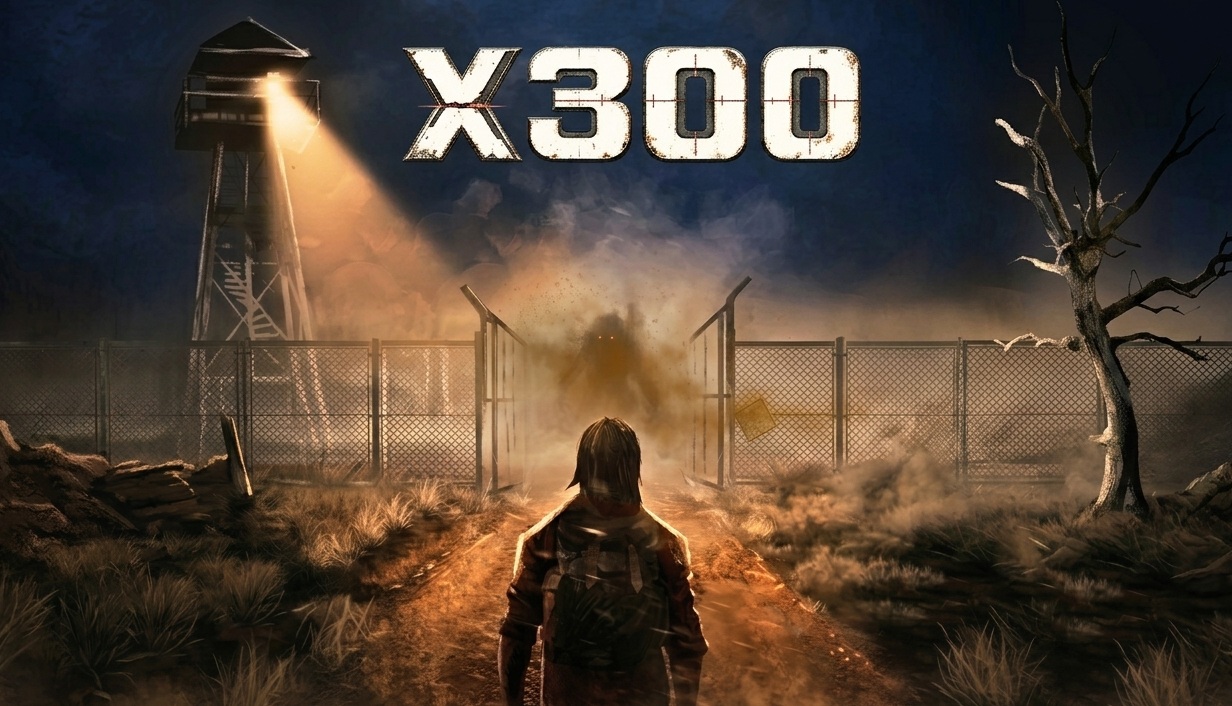
I went hands-on with Covyne Entertainment’s X300 at PAX Aus 2026, and between its unsettling Cold War mystery, distinctly Australian horror and some rather unfortunate encounters with drop bears, this is one indie horror game worth keeping an eye on.
There’s something uniquely unsettling about horror rooted in familiar places. Abandoned buildings, forgotten government facilities and the vast isolation of the Australian outback all carry an atmosphere that’s difficult to replicate. Independent Australian developer Covyne Entertainment is looking to tap into that unease with X300, a psychological survival horror game that takes Australia’s Cold War history and turns it into something deeply disturbing.
First teased last year, X300 was playable on the show floor at PAX Aus 2026, giving me my first opportunity to experience what Covyne Entertainment has been building. After spending time with the game, I came away intrigued by its approach to psychological horror, particularly its focus on environmental storytelling, uncertainty and the uncomfortable feeling that something isn’t quite right.
And, of course, there were the drop bears.

X300 puts players in the shoes of Bruce Mercer, a man searching the Australian outback for his missing brother. What begins as an investigation quickly spirals into something far more sinister, leading Bruce towards a classified underground facility with a history stretching back to the Cold War.
The facility is where X300’s central mystery begins to take shape. Players must navigate a place that appears to exist across different periods, with strange time anomalies connecting an abandoned installation from the 1980s to its operational counterpart in the 1950s. The result is an environment where the past and present begin to blur, leaving players questioning what they’re seeing and whether the people they encounter should even be there.
It’s a compelling premise, particularly given the Australian setting. The country’s history, remote landscapes and isolated communities provide fertile ground for a story about secrecy, institutional paranoia and places deliberately erased from public memory.
Rather than relying on a familiar haunted house or an outbreak of monsters, X300 builds its identity around the unsettling possibility that something has been hidden in plain sight for decades.

Horror that makes you question what you’re seeing
X300 isn’t trying to be a fast-paced action horror game. Its approach is considerably more restrained, drawing on the slow-burn psychological horror of games like Silent Hill, SOMA and Amnesia: The Bunker.
The emphasis is on atmosphere, exploration and the small details that make an environment feel wrong. A telephone line that shouldn’t be connected can still answer. People remain at their posts long after they should have left. Conversations don’t always make sense, and memories don’t necessarily line up with what the player discovers.
These are the kinds of details that make X300 interesting. The horror isn’t always immediately obvious, and the game encourages players to pay attention rather than simply push forward in search of the next scare.
During my time with the game at PAX Aus, that sense of uncertainty was one of its most intriguing qualities. X300 wants you to look around, question what you’re being told and wonder whether the world you’re exploring can be trusted.
It’s an approach that could prove particularly effective if the full game maintains that level of environmental detail and mystery. Psychological horror is often at its best when it gives players enough information to form theories without necessarily providing immediate answers.

An Australian indie horror game worth watching
My time with X300 at PAX Aus 2026 left me curious about where Covyne Entertainment will take its unsettling premise. Its Australian identity gives it a point of difference, while the combination of Cold War history, time anomalies and psychological uncertainty provides a strong foundation for a memorable horror experience.
What interests me most is the game’s apparent commitment to making players question their surroundings. The idea that a location can feel abandoned while still being occupied, or that the people within it might be operating according to a reality we can’t understand, is an effective foundation for psychological horror.

Naturally, a convention demo only offers a snapshot of the finished experience. There are still questions about how the mystery develops, how its survival mechanics evolve and whether the atmosphere can sustain itself across the full game. Those are things I’ll need to experience before making any definitive judgements.
For now, though, X300 has given me plenty of reasons to keep an eye on it.
X300 is in development at Covyne Entertainment and can be wishlisted on Steam. If you’re a fan of atmospheric survival horror, environmental storytelling and mysteries that leave you questioning what you’ve just experienced, this is one Australian indie project worth adding to your watchlist.
Just remember to keep an eye on the trees.
You never know what’s waiting up there.
Leave a Reply